
Words scream out from the white walls, a quiet fury, a poem, a story disjointed – scattered and displaced like our people.
Most (if not all) art is about storytelling when you dive into it; the layers of meaning peel back as you dive deeper, then enfold you like a hug as you pass. If you are not ready for it, if you deny the truth, art can smother. This is true of all forms of art, from the obvious storytelling of literature, to hard and impenetrable forms of ceramic. Ceramics by Indigenous artists, a small genre for now but growing like bull kelp, is the making of art from the land itself – clay and glazes, minerals and dirt, story and thought made hard by fire.
Regardless of its hardness you can penetrate below the surface to see the story within, carve into the surface to probe the meaning beneath.
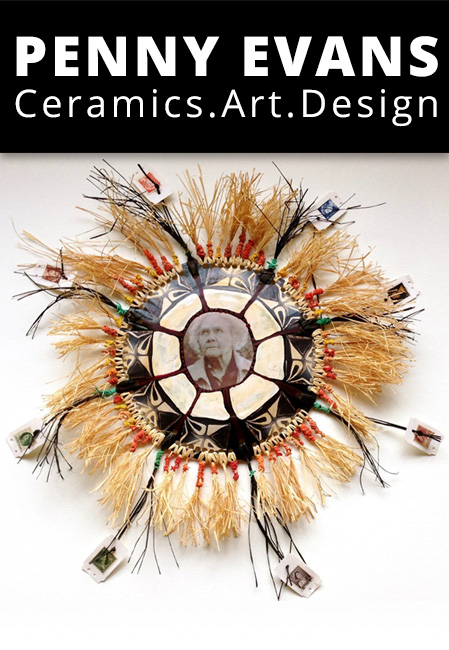
Ceramics are a form of metamorphic rock. Clay, silica, and minerals are transformed by heat to create something new and permanent – perhaps the most permanent of items – they cannot corrode or age, only break. Penny Evans has taken this material and transformed it into wall pieces telling the story of the colony; working with permanence, so eternal it belongs in what Stanner named the everywhen1.
The artist has unpacked and interrogated the story of the colony (that brought us ceramics through trade) with this eternal material, exposing our peri-colonial nation, displaying and interrogating the moment in which the colony dominates – perhaps in the hope that this baby nation called Australia might one day become post-colonial. These stories echo in the zeitgeist, in this time when the colonial oppression of our people has started to become unacceptable (although the 2023 Federal Voice Referendum result tells us we have a long way to go).
This body of work tells a dramatic story, the arrival of the colonisers, the oppression of our people, and the future decolonisation that already exists in the eternal now. The story is there in black and white, blurring the line between poetry and stone, between sculpture and text, between artefact and art, between art and artifice. This follows and expands upon a long modernist tradition of Indigenous text-based protest works, which includes the startling designs of Vernon Ah Kee and the banner-paintings of Richard Bell. The Evans sculptures weaponise the shapes of Aboriginalia and kitsch in a way that seems to pay tribute to the installations of Tony Albert.
This is art as activism, art as politics.
—– READ THE FULL ARTICLE: Download the PDF copy of this article [PDF: 2.7mb]
Image: Penny Evans, In Black and White (detail), 2023, porcellaneous stoneware, underglazes carving, sgraffito, dimensions variable; photo: Michelle Eabrey
Read the full article at australianceramics.com/shop/the-journal-of-australian-ceramics-vol-63-no-1-april-2024-jac-631